
“Tech Is the New Bank”
“Tech Is the New Bank”
Investing in the Revenue Infrastructure
Brazil built the most advanced financial infrastructure in the emerging world. The next decade of value creation belongs to the companies that connect to it, build on it, and monetize it.
Every venture capital thesis begins with an observation about where the world is going that most people haven't internalised yet. Ours begins with a question: What is the business customer journey and what kinds of business services and technologies will help customers along this journey, from the moment a customer is acquired until it becomes investable capital, insurable risk, or cross-border payment?
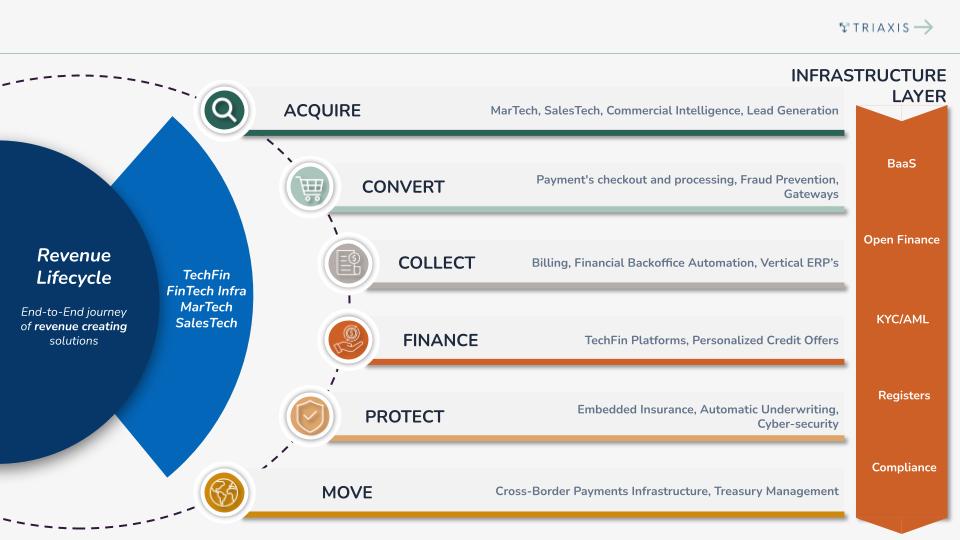
The answer is that at every stage of that journey: acquiring customers, converting the sale, collecting the revenue, financing the business, protecting the operation, and move capital across borders, there is a technology company capturing value by making the transition faster, cheaper, or more intelligent.
We spent twelve years investing in these companies before we had a name for what we were doing. Then we mapped our exits and our portfolio against this chain, and the pattern became undeniable.
ACQUIRE → CONVERT → COLLECT → FINANCE → PROTECT → MOVE
We call it the Revenue Lifecycle. It is not a marketing framework. It is a map of where value accrues in the digital economy; and this is where we invest.
The Central Bank built the roads. Now startups build the cars.
Between 2018 and 2026, the Central Bank of Brazil executed one of the most ambitious financial infrastructure programs in the world: direct lending authorization for fintechs; receivables ownership reform; free transactions through Pix, an instant payment system that now processes nearly eight billion transactions per month and reaches 93% of the adult population; Open Finance with over 60 million active consents and 700+ participating institutions; FIDC reform that opened structured credit to retail investors; Pix Automático for recurring payments; and now, stablecoin regulation.
Key financial ecosystem metrics:
170M+ adults using Pix: 93% of Brazil's adult population.
$6.7 trillion in Pix transaction volume in 2025, growing 34% year over year.
62M+ Open Finance active consents, up 45% from 2023.
No other emerging market has assembled this combination of regulatory infrastructure, digital adoption, and market scale. The infrastructure is built. The question is no longer whether Brazil will have a modern financial system. The question is who will build the software that makes it work.
Governments build infrastructure. Entrepreneurs monetise it. The Central Bank of Brazil has done its job. Now it's our turn.
The most valuable fintech companies are the ones consumers never see.
The last decade of Brazilian fintech was about consumer-facing applications: neobanks, payment apps, digital wallets. The next decade will be about the invisible infrastructure that makes those applications work: the fraud engine that approves the transaction; the billing platform that manages the subscription; the ERP that originates the credit; the insurance layer that protects the contract; the stablecoin rail that settles the cross-border payment.
This is not a new insight globally. Ribbit Capital understood it when Micky Malka launched a $100 million fintech-only fund in 2012 and backed Coinbase, Robinhood, and Nubank at Seed. That fund returned approximately 63 times. QED Investors understood it when they built an $800 million fintech specialist fund. Clocktower Tech Ventures understood it when they focused exclusively on financial services infrastructure.
What none of them have done is to apply this thesis systematically to Brazilian early stage startups, the stage where the entry valuations are fair, the infrastructure tailwinds are strongest, and the return asymmetry is greatest.
That is what we do.
Product to platform. Software to TechFin. $X to $10X.
The Revenue Lifecycle is not just a way to classify companies. It is a value creation playbook. Every company we invest in enters the lifecycle at one stage. Our job is to help it expand into adjacent stages, transforming a point solution into a platform, and a SaaS subscription or transaction service into a financial relationship.
The economics are straightforward. A vertical ERP charging $X per year becomes a $10X relationship when it layers embedded credit, powered by FIDCs, using the transactional data it already holds. The customer acquisition cost doesn't change. The switching cost increases dramatically. The revenue per customer multiplies by five to ten.
We didn't invent the framework. We discovered it in our own exits.
Before we had a name for the Revenue Lifecycle, we were already investing in it. Our first fund deployed R$172 million into 35 companies. The exits we've executed have already returned over 2X that and are still expected to return another 2X. The fund has already exceeded the hurdle rate with twelve portfolio companies still pending divestment.
Four of our five top exits sit squarely in the Revenue Lifecycle:
Bling → acquired by Locaweb: Stages Collect & Finance
EZ-commerce/DCG → acquired by Linx: Stage Acquire
Vindi → acquired by Locaweb: Stage Collect
Konduto → acquired by Boa Vista/Equifax: Stages Convert & Protec
We invested in each at Seed. We helped them execute the product-to-platform pivot. And we exited them to strategic acquirers who understood that these infrastructure assets are worth multiples of their standalone revenue. When we mapped our entire portfolio against the six stages, the pattern was unmistakable. We had been investing in the Revenue Lifecycle for a decade. We just hadn't named it yet.
The window is open.
Five structural tailwinds will converge in the next few years:
Pix Automático: launched in June 2025, enabling native subscription billing through Pix, reaching 60 million Brazilians without credit cards. The entire billing infrastructure layer is being rebuilt from scratch.
Open Finance: has crossed the monetization threshold, with 102 billion API calls in 2024, +96% growth year over year.
The FIDC reform: (CVM Resolution 175) democratized structured credit. Any vertical ERP with receivables data can now originate credit products, creating an entirely new category of techfin companies.
Stablecoin regulation: is being formalised, with USDT trading volume in Brazil tripling to $1.6 billion monthly.
The companies that occupy the structural control points of the Revenue Lifecycle in the next few years will define who owns the infrastructure layer of Brazil's digital economy for the next decade.
In venture capital, the returns go to the investors who see the infrastructure shift before it became obvious, and have the conviction to back it at the earliest stage.
Triaxis is perfectly positioned for this moment.
We are not generalists who happen to invest in fintech. We are not a later-stage VC writing larger checks into de-risked companies. We are not international investors "parachuting" into a market without local knowledge.
We are a team that has worked together for over twelve years, investing exclusively in Brazilian technology from Seed to exit. We have made more than 50 investments and executed exits to Locaweb, Equifax, Linx, J.P. Morgan/FitBank, and Eletromídia. We work with strategic investors whose expertise directly activates portfolio companies at specific stages of the Revenue Lifecycle.
In a landscape of competing and adjacent funds, no other firm replicates our combination of fintech infrastructure specialization, full-cycle exit track record, systematic thesis framework, and strategic investment structure.
The Revenue Lifecycle is not a bet on any single company, technology, or regulatory outcome. It is a bet on the most fundamental shift in Brazilian financial services: that the infrastructure layer of the digital economy will be built by startups, not by banks, and that the investors who back these startups at Seed and Series A will capture the most value.
We are not competing to be the largest fund. We are competing to be the most precisely positioned fund in the most attractive segment of Brazilian venture capital.
Tech is the new bank. The Revenue Lifecycle in where the value is.
Reinaldo Coelho
Founding Partner, Triaxis Capital